The End of The Human Race?
By Brent Thomson
I had an inkling of an idea and so I spent some time working through a thought experiment with the help of AI. The line of thinking goes something like this:
The current global life expectancy is around 72 years. In the wealthiest countries, it's around 82 years. This is data. We can argue about why or whether that's fair or whatever, but those are the stats.
The wealthiest people have passive income that exceeds their expenses. This means they get richer with the passing of time. This, in turn, means that the richest people get richer as they get older.
The average age of maximum net worth for a person (globally) is around 50 years. The average net worth (again, globally) for 50-yr-olds is $82k.
So, the average human net worth peaks at 50 years old, but the net worth of the richest peaks at the person's death. This exactly matched my intuition, which brings us to my big question:
What happens to the relative wealth of the richest people, compared to the average person, as life expectancy increases?
I defined the "wealthiest people" as the 100 people in the world with the highest net worth. Today, the average member of the top-100 list has a net worth about 500,000 times the average 50-yr-old human's net worth. AI (Claude in this case) predicts that this multiple increases to 5.5 million times the average net worth if life expectancy increases to just 100 years.
It becomes truly terrifying when we extrapolate a little more. If we say the average life expectancy reaches 300 years (currently science fiction territory, but still short of immortality), the net worth multiple for the 100 wealthiest humans is ... wait for it ... 2 quadrillion (one million billion) times the net worth of the average 50 year old, even if that 50-yr-old also sees a dramatic increase in life expectancy. Some observations:
This calculation generously assumes the average person's net worth remains constant post-50 (in reality, it decreases).
That astronomical wealth concentration demonstrates the power of compound interest.
That degree of relative wealth comes with a corresponding degree of relative power under today's economic-political realities.
Because of the way power laws work, the top 10 of the top 100 wealthiest people would likely control the vast majority of the assets of the entire cohort, which means that the world economy would be dominated—completely, perfectly, entirely—by less than a dozen people. And economic power === political power.
Those 10 would effectively be dictator-gods. Their only competition would be each other and the stakes would be monumental. I'd expect nuclear conflict and extermination of one's enemies to absolutely be on the table. And once you're reasonably sure your foe is about to nuke you ... well ... the reasonable response is to strike first. But your enemies have the same idea and all we wind up with is mutual extermination.
That's one end-of-world scenario that a 2QX wealth gap could cause, but it's not the only one. Under the current global economic system, those wealthiest 300-yr-olds would be entirely immune to any kind of regulation or outside influence. They'd be free to extract anything from anyone and to cause any environmental, social, or financial damage that might suit them, and nobody could do anything about it without a literal revolution. But any revolution would require all of humanity to rise up against the overlords in unison (because of the vastness of the disparity of resources). But the wealth-gods would be the ones with their finger on whatever red buttons they had devised. Again, the human race effectively gets wiped out.
We could brainstorm a dozen more futures where the 10 or 100 "haves" own literally everything (and we totally should; it sounds nihilistically fun), but I suspect they'll mostly be variants on either uber-distopia or perfect annihilation.
In short (and ironically), extending human life expectancy to even 300 years under the current political-economic system is very likely to end the human race.
I see a few potential paths which could generate an equilibrium (doesn't qualify as a happiness-inducing solution) short of the self-extermination of our species. I'll ignore third-party interventions like aliens and rapture-ization since we have no control over those. These ideas aren't well thought out yet, and have only been swirling in my mind for about an hour:
Something happens which doesn't wipe out humans but it decreases total human wealth enough that a few elites simply can't control enough of the global economy to exercise autocratic control over all of humanity without also wiping out humanity. This would be a grim and stagnant scenario and would only save us temporarily. If enough of humanity remained intact that we could start to rebuild, we'd likely reach the same wealth+power disparity condition again in the future and face the same risk of extinction.
Energy becomes free and universally available. With free and abundant energy, the ability of the select few to control other humans disappears since those humans can simply choose to detach from the system controlled by the elites. This defense goes out the window, however, if the elites build a Monty Burns-style sun blocker to prevent the proles from harvesting solar radiation. And this concept comes with a paradox: The elites will be in a position to influence the development and deployment of such an energy system. *sigh*
Humanity starts migrating off-earth before we achieve really radical increases in life expectancy. I haven't decided yet whether I think the elites would prevent the commoners from leaving or just let them disappear and stop causing trouble.

I don't have any solutions to propose, no clever takeaways, and I won't bother with a summary of the thoughts I've already shared. Maybe there's something to think about here. Maybe it's just poorly-written science fiction. Most of my speculation is likely to be very wrong, but I had fun imagining variations of future humanity.
-Brent
Brent sent me this email yesterday as a guest post. I really love when people say things that are super smart. Brent is always doing this when he gets in groups of people. I will share his thoughts on meritocracy and incumbency in later guest posts essays. Brent is no stranger to success in business and technology, as founder of Jive and Blip Billboards. He is also a very good human as anyone that gets to know him can attest.
Happy 4:20
SP
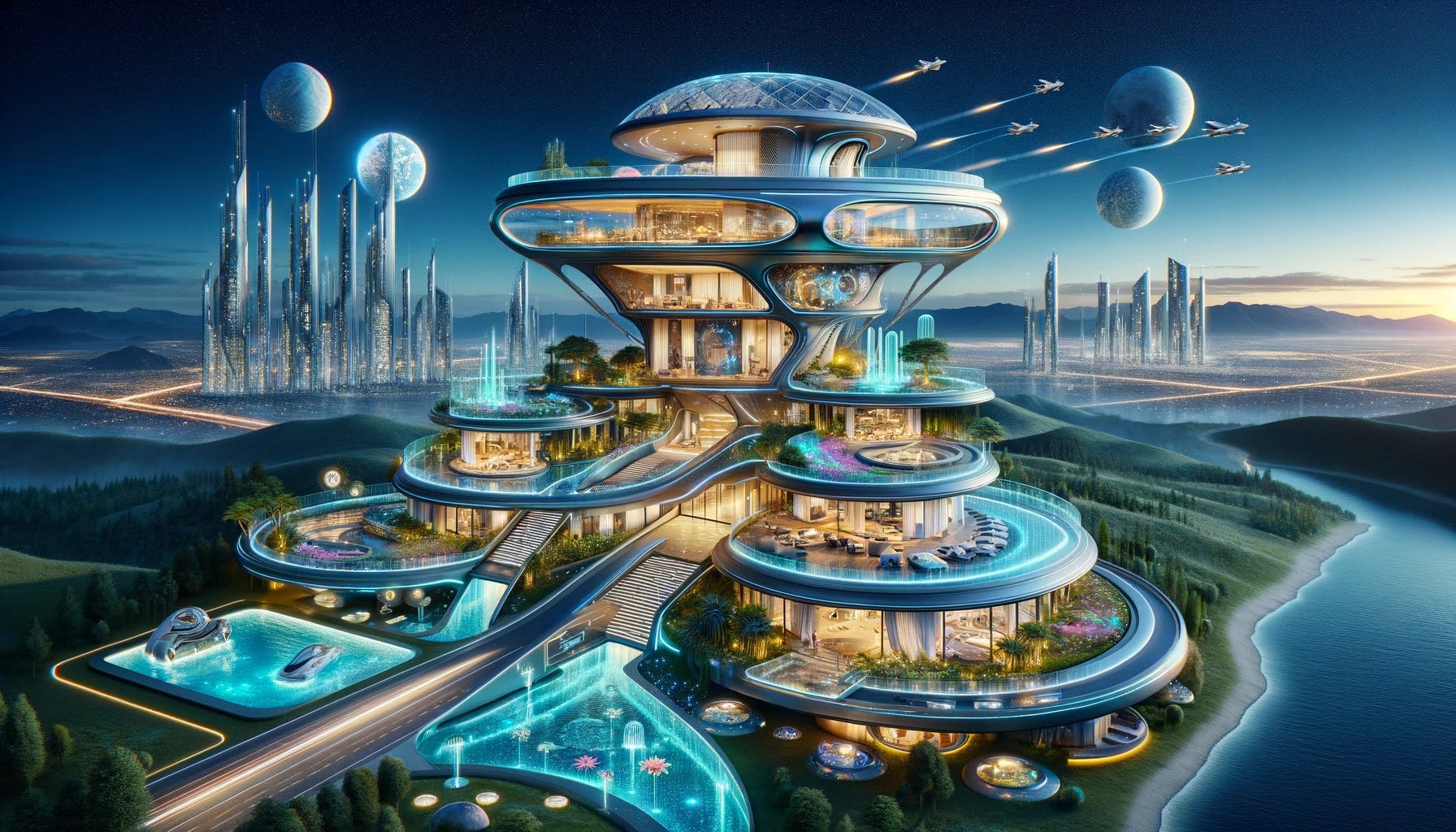
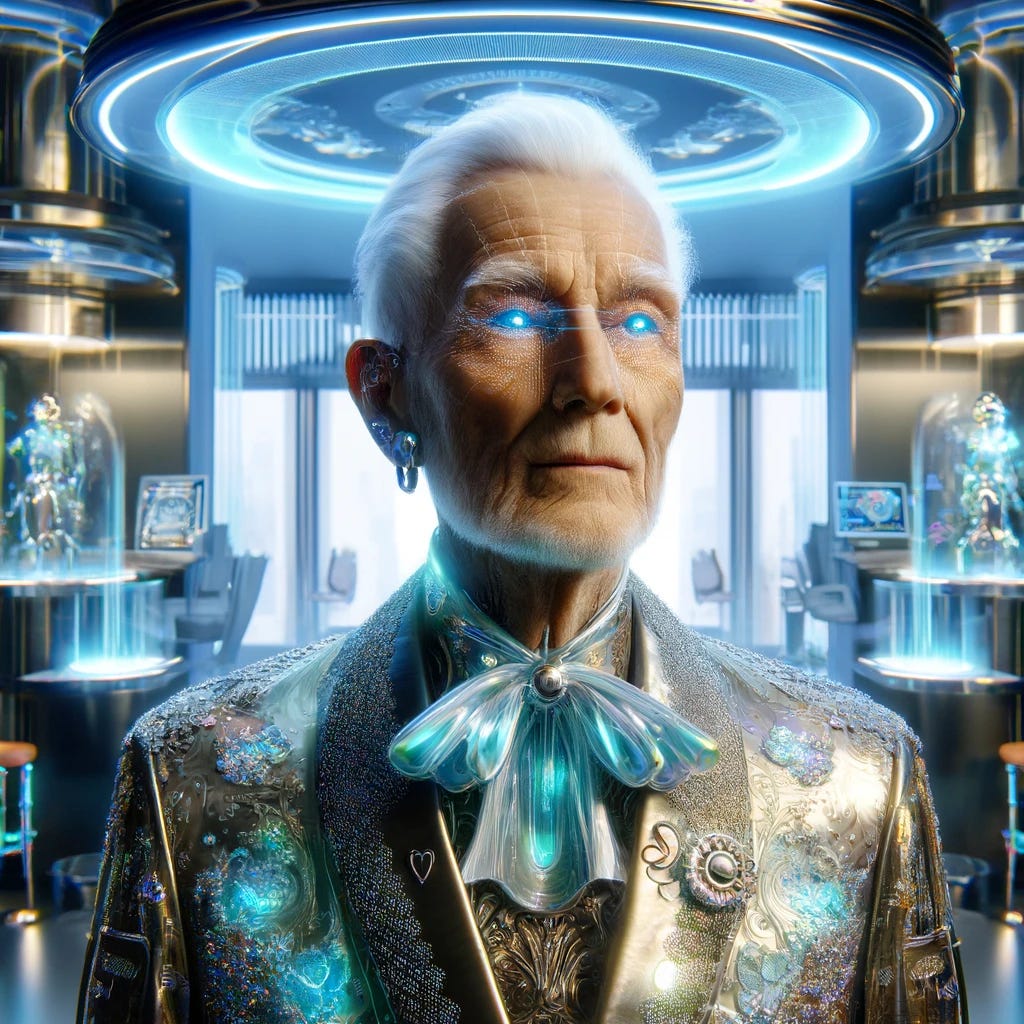
Here are the images for today:
Scott: What would a person who lived to 300 and had trillions of dollars look like in the year 2250?
What type of home would they live in?