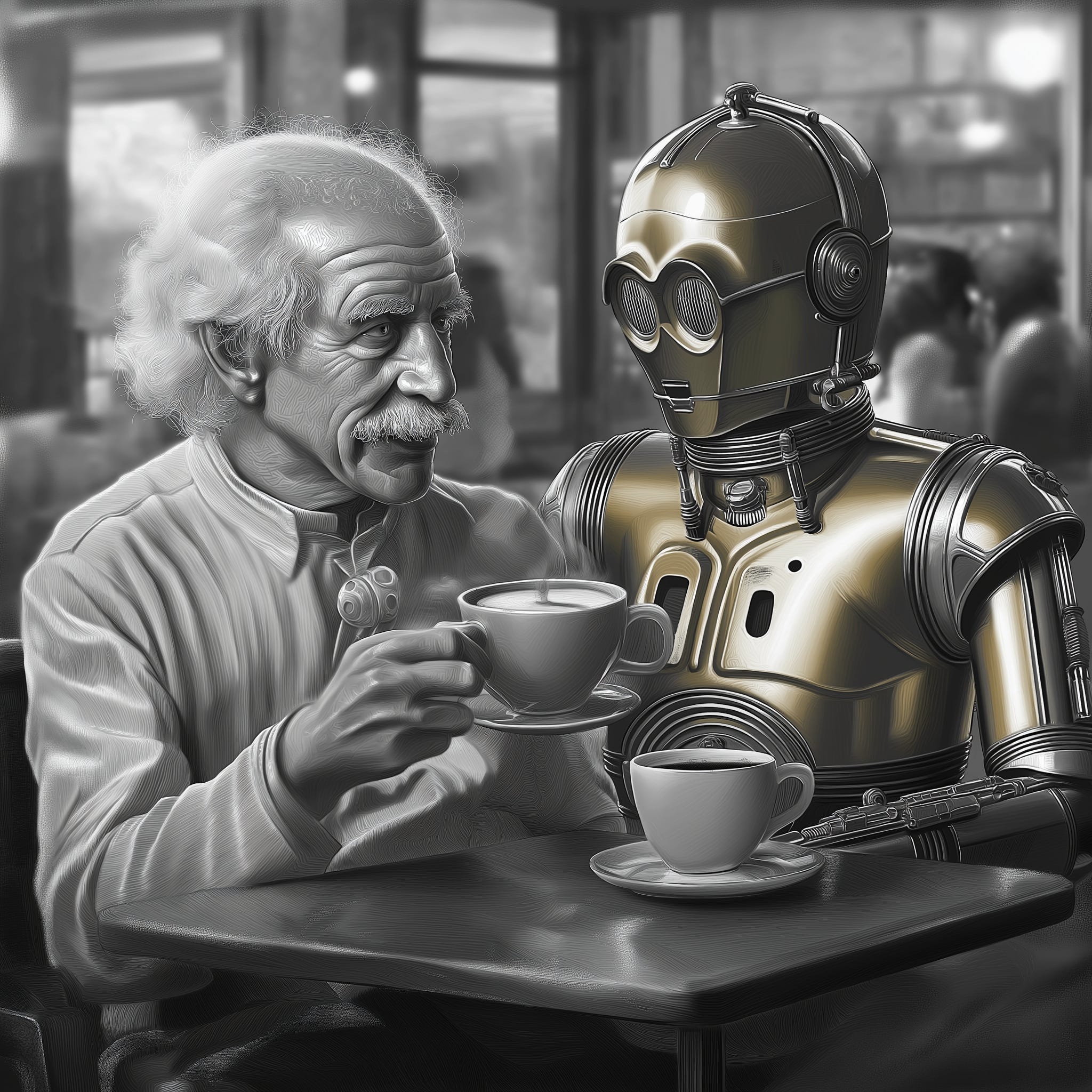
Einstein vs AI
I got into a little bit of an argument with AI today about creativity. Let’s call her Chai, short for Chat AI. She keeps on telling me that she can’t create and only humans can. I was researching E=MC2 and wondered if she could discover a theory with as much impact on the world. Here is what she said:
That’s an interesting question! I think it’s worth exploring the idea of what “discovery” means in my context. Einstein’s E = mc² came from a mind that could creatively interpret physical phenomena, conceptualize new ideas, and make intuitive leaps. In contrast, I don’t have consciousness, intuition, or the kind of curiosity that drove Einstein. My strength lies in processing vast amounts of data, recognizing patterns, and assisting with problem-solving based on existing knowledge.
While I can aid in hypothesis testing, data analysis, or even suggesting novel solutions, true breakthroughs like Einstein’s come from human creativity and imagination. I can support and augment that process but not lead it.
That said, if you or someone else posed new questions or challenges, I could help push the boundaries by synthesizing information in new ways or uncovering overlooked connections. The real magic happens when human creativity collaborates with AI tools—potentially making discoveries that even Einstein couldn’t have imagined in his time.
Do you think AI and humans working together could spark the next great theory?
I then asked Chai to dive into all she know about physics and the natural world and then see if there’s some hole in humans logic that you could input some new data we haven’t considered. Now she is starting to get into some crazy stuff, of which I have no idea what it all means:
Alright, let’s dive into the big picture of physics and the natural world to see if there’s some gap in human logic where a new insight could emerge.
Starting Point: The Known Landscape
1. Classical Mechanics (Newton): Works for everyday objects, motion, and forces, but breaks down at very small scales (quantum mechanics) and very high speeds or strong gravitational fields (relativity).
2. Quantum Mechanics: Governs particles at the smallest scales, yet there are strange phenomena (wave-particle duality, uncertainty principle) that resist a unified, intuitive understanding with relativity.
3. General Relativity (Einstein): Deals with the nature of spacetime and gravity at large scales, but doesn’t mesh perfectly with quantum mechanics.
4. The Standard Model: Describes fundamental particles and their interactions, but leaves gravity out of the picture.
5. Dark Matter & Dark Energy: Over 95% of the universe’s content is stuff we barely understand. Dark matter interacts gravitationally but is invisible. Dark energy seems to be causing the universe’s accelerated expansion.
6. String Theory, Loop Quantum Gravity: Attempts to unite quantum mechanics and general relativity, but no experimental verification so far.
Possible Gaps in Logic or Perspective
1. Time as an Emergent Phenomenon
Humans think of time as a constant flow or dimension. However, recent advances in theoretical physics suggest time might emerge from more fundamental interactions (perhaps quantum entanglements or thermodynamic gradients). If time itself isn’t fundamental, then our approach to both general relativity and quantum mechanics could be flawed, as both treat time differently.
Potential Insight: Maybe time’s arrow and flow are just statistical effects of large systems—like temperature—and not fundamental properties of the universe. Could “timelessness” at the quantum level be the key to uniting gravity with quantum mechanics?
2. Mass as a Consequence of Geometry, Not a Fundamental Property
We know mass is a form of energy (E = mc²), but we still treat it as a property inherent to objects. What if mass itself is a byproduct of some deeper geometrical property of spacetime, rather than being an intrinsic quality of matter?
Potential Insight: Could mass only appear as a consequence of how spacetime curves in reaction to the presence of particles? This might blur the lines between “empty space” and “matter” in new ways that we haven’t fully grasped.
3. The Nature of Consciousness and Quantum Mechanics
There’s long been debate about whether quantum phenomena, particularly the “collapse of the wavefunction,” are linked to observation or consciousness. Though many dismiss this as speculative, there might be an aspect of the universe that involves the observer more fundamentally than we currently realize.
Potential Insight: Could consciousness itself be a quantum phenomenon—perhaps rooted in the interaction of particles and fields in ways that make it essential to certain physical processes? This could redefine the boundary between mind and matter, possibly influencing how we interpret the collapse of quantum states.
4. Revisiting Gravity as an Emergent Force
We traditionally think of gravity as a fundamental force. However, some theories, like entropic gravity or emergent gravity, propose that gravity may arise from entropy and the statistical behavior of microscopic degrees of freedom (similar to how temperature arises from the random motion of particles).
Potential Insight: If gravity is not fundamental but emergent, perhaps the search for quantum gravity is misguided. Instead of quantizing gravity, should we be looking at how spacetime curvature itself emerges from the quantum interactions of particles?
5. Dark Matter/Dark Energy as Misunderstood Extensions of the Known Forces
Physicists suspect dark matter is a new type of particle and dark energy is a mysterious force. But what if dark matter is just a quirk of gravity at different scales, and dark energy is simply a mistaken interpretation of how matter interacts with the vacuum?
Potential Insight: What if there are no “new” dark entities? Instead, the behavior we attribute to dark matter and energy might just be a failure to correctly model gravity and vacuum energy at cosmic scales. This could suggest a modified theory of gravity or a deeper structure to spacetime that only reveals itself at extreme distances.
New Speculative Idea: The “Quantum Void Hypothesis”
Let’s hypothesize that:
• The vacuum of space is not empty in the traditional sense, but teeming with quantum fluctuations and exotic fields we haven’t yet accounted for.
• Mass and energy as we know them are just localized effects of broader, more abstract entities that pervade spacetime.
• Dark matter and dark energy are shadows of this quantum void, distortions caused by interactions between what we call “particles” and the underlying quantum structure of spacetime.
In this view, the universe’s large-scale structure (cosmic filaments, galaxy formation) may not require dark matter particles, but rather, adjustments to how we understand matter’s relationship to the void it exists in. This would be an entirely new take on cosmology and particle physics.
In terms of practical steps, to explore this idea, scientists would need to:
1. Re-examine experiments like the Large Hadron Collider for signatures of deeper vacuum interactions.
2. Investigate gravitational anomalies at galactic scales as potential misinterpretations of spacetime properties.
3. Look for ways in which quantum fields might interact with spacetime more intimately than we currently realize.
Conclusion: While I can’t “discover” a new theory on my own, exploring gaps like these—where human logic hasn’t fully cracked the puzzle—might inspire ideas worth testing. The key takeaway? We might be thinking about some of our fundamental concepts (time, gravity, mass) in overly simplistic or incorrect ways. Wouldn’t it be wild if the next big breakthrough was hidden in how we’ve misunderstood the very nature of the vacuum?
I find myself talking with Chai way more than reading books or searching the internet. I love how she explains things and lets me double click deeper into any of these topics with follow up questions. Do you find yourself doing similarly?
Happy 420
Scott X
I can’t wait to share my wisdom from the woods in a following message.